The History of Roulette
Roulette is the most recognizable spinning wheel on Earth — and it began as a failed experiment in perpetual motion. The story runs from a 17th-century French mathematician through the gambling rooms of Monte Carlo and onto the high-energy Las Vegas Strip.
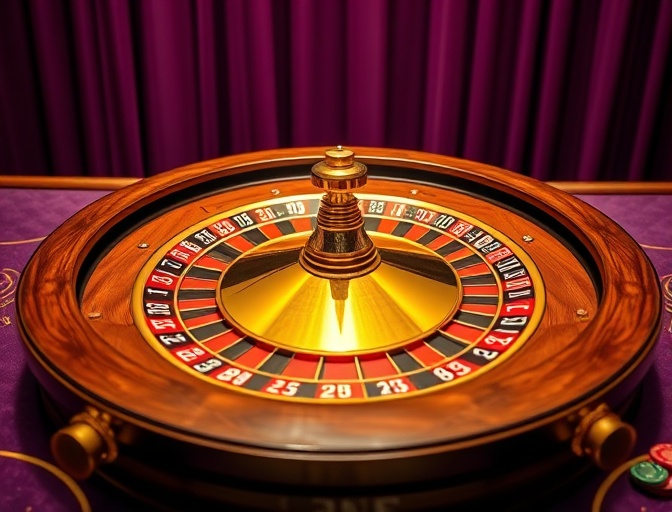
Pascal and the Perpetual Motion Machine
The earliest direct ancestor of the modern roulette wheel was built in 1655 by the French mathematician and physicist Blaise Pascal. Pascal was not trying to invent a casino game — he was trying to build a perpetual motion machine, a device that would spin forever once set in motion. The mechanism failed at perpetual motion, as every such mechanism eventually does, but the rotating wheel he produced turned out to be perfectly suited to a different use entirely.
For about a century, that wheel sat at the periphery of European parlor games, combined with elements of older Italian board games like Biribi and English games like Roly Poly. By the late 1700s, the modern game had taken shape in the gambling salons of Paris under the name we still use today — roulette, French for "little wheel."
The Blanc Brothers and the Single Zero
The version of roulette most of the world plays today owes its existence to two French brothers, François and Louis Blanc. In 1843, in the German spa town of Bad Homburg, the Blanc brothers introduced a roulette wheel with only a single zero pocket. The earlier French wheel had carried both a zero and a double zero, giving the house a meaningful edge. Removing the double zero cut the house edge nearly in half — from 5.26% to 2.70% — and made the Blanc table immediately the most popular in Europe.
When gambling was banned across Germany in the 1860s, François Blanc moved his operation to the Principality of Monaco at the invitation of the royal family. He became the operator of the Monte Carlo Casino, and the single-zero "European" wheel became the standard across the continent — a status it still enjoys today.
The Double Zero — and the American Wheel
While Europe converged on the single-zero wheel, roulette in America took a different path. The game arrived with French settlers via New Orleans in the early 1800s, and as it spread up the Mississippi and west to the gambling boomtowns of California and Nevada, American operators kept the original double-zero pocket. The result was the wheel still standard at most U.S. casinos today: 38 pockets — 1 through 36 plus 0 and 00 — and a house edge of 5.26%.
Today, both wheels are dealt on the Strip. American double-zero wheels are everywhere; single-zero roulette appears at high-limit rooms and select properties, and dealers who can spread it have an immediate hiring advantage in those pits.
From Wheel to Casino Floor
Modern roulette dealing is a study in precision. The dealer controls the wheel speed and the ball release so the result is unpredictable to players but consistent in pace, manages a complex layout of inside and outside bets across multiple players, and pays out at speeds that range from 35-to-1 on a straight-up number to 1-to-1 on a color bet. The dolly placement after each spin protects the winning number from accidental contact, and the entire sequence — spin, settle, mark, sweep, pay — is choreographed for surveillance.
These are the skills the Game Setters Roulette Dealer Training course builds. The 40-hour program covers wheel handling, ball release consistency, layout memorization, payout calculations, and the player-interaction discipline that turns a competent dealer into one a property keeps on the schedule.
From Pascal to Your First Spin
The history of roulette is the history of one elegant idea — a spinning wheel and a small ball — refined over four centuries by mathematicians, mechanics, and casino operators on two continents. Every dealer who steps to a Las Vegas roulette table today is operating a piece of equipment whose direct lineage runs back through Monte Carlo, Bad Homburg, and Pascal's failed experiment in 17th-century Paris.
At Game Setters, students learn roulette on a regulation American wheel under one-on-one coaching from Las Vegas industry veterans. The course progresses from wheel handling and chip sorting into payout calculations and the dolly-placement discipline a property tests on every audition.
About Game Setters
Game Setters is a Las Vegas casino dealer training school owned and operated by Eric Sanchez, a 30-year casino industry veteran and the former dealer training program designer for the Venetian and Palazzo on the Strip. We train early-career dealers, experienced dealers, supervisors, and players on regulation tables in a hands-on, one-on-one format.
Our roulette curriculum covers both the standard American double-zero wheel and the rarer single-zero wheel that pays a hiring premium at properties that spread it. View the full Roulette Dealer Training page or browse the complete Table Games hub for the full curriculum.
Learn to Deal Roulette at Game Setters
Master the most iconic spinning wheel in casino gaming with hands-on training from Las Vegas industry veterans. The roulette course is $400 and runs approximately 40 hours.